NHL Free Agency 2026 Tracker: Live Signings
Free agency opens noon ET July 1, 2026 with the largest cap leap of the cap era. Live tracker, top UFAs, cap-space leaders, and the Frenzy Premium framework that explains what the first six hours actually pay for.
Live updates
No updates yet. Refreshing automatically.
NHL Free Agency 2026 opens at 12:00 PM Eastern Time on Tuesday, July 1, with $8.5 million in new cap space landing on every team's spreadsheet, the largest single-year jump of the cap era. The 2026-27 salary cap upper limit is locked at $104 million, up from $95.5 million in 2025-26, with the floor moving to $76.9 million. Free agency itself works the same way it always has, an open noon ET window where any team can sign any unrestricted free agent, but the supply-demand math this year is unusual. Most of the elite UFAs the market expected six months ago have already extended, so the dollars chase a much thinner board.
Free agency is open and the board is moving fast. Every deal below is verified against PuckPedia plus an independent report. The confirmed table lists deals with an official contract page live; the reported table carries deals broken by named insiders (Elliotte Friedman, Pierre LeBrun) that PuckPedia has not posted yet. The pre-market analysis further down predates the noon open, so where it differs from the confirmed table above the table is current.
"NHL officially informs teams of the 2026-27 Salary cap and payroll range: Floor: $76.9M Midpoint: $90.4M Ceiling: $104M Maximum salary: $20.8M"— Elliotte Friedman, Sportsnet (via X)
| Player | Team | Contract | Type |
|---|---|---|---|
| Bowen Byram | Chicago Blackhawks | 6 × $12.5M ($75M) | Trade + extension |
| Nico Hischier | New Jersey Devils | 5 × $11.7M ($58.5M) | Re-signed |
| Pavel Dorofeyev | New York Rangers | 7 × $11.0M ($77M) | Sign & trade |
| Alex Tuch | Washington Capitals | 8 × $10.5M ($84M) | Sign & trade |
| Dan Vladar | Philadelphia Flyers | 5 × $5.5M ($27.5M) | Extension |
| Viktor Arvidsson | Detroit Red Wings | 2 × $5.0M ($10M) | UFA signing |
| Eetu Luostarinen | Florida Panthers | 8 × $5.0M ($40M) | Extension |
| Ian Cole | Chicago Blackhawks | 1 × $4.0M | UFA signing |
| Mackie Samoskevich | Seattle Kraken | 3 × $3.85M ($11.55M) | Extension |
| Jaden Schwartz | Colorado Avalanche | 3 × $3.25M ($9.75M) | UFA signing |
| Olen Zellweger | Buffalo Sabres | 3 × $3.1M ($9.3M) | Re-signed (RFA) |
| Cole Smith | Chicago Blackhawks | 3 × $3.0M ($9M) | UFA signing |
| Samuel Ersson | Ottawa Senators | 2 × $2.2M ($4.4M) | UFA signing |
| Ross Johnston | St. Louis Blues | 3 × $2.0M ($6M) | UFA signing |
| Radko Gudas | Florida Panthers | 6 × $1.5M ($9M) | Sign & trade |
| Ryan Lomberg | Columbus Blue Jackets | 2 × $1.3M ($2.6M) | UFA signing |
| Noah Juulsen | Colorado Avalanche | 2 × $1.1M ($2.2M) | UFA signing |
| Carter Mazur | Detroit Red Wings | 2 × $875K ($1.75M) | Re-signed |
| Dennis Gilbert | Buffalo Sabres | 1 × $850K | Re-signed |
Reported deals below are sourced to named Tier-1 insiders and awaiting an official PuckPedia contract page. Figures shown are the reported terms.
| Player | Team | Contract | Type |
|---|---|---|---|
| Ivan Demidov | Montreal Canadiens | 8 × $9.15M ($73.2M) | Re-signed (RFA) |
| Rasmus Andersson | Vegas Golden Knights | 7 × $8.5M ($59.5M) | Re-signed |
| Sergei Bobrovsky | Toronto Maple Leafs | 3 × $7.0M ($21M) | UFA signing |
| Erik Haula | Los Angeles Kings | 2 × $3.6M ($7.2M) | UFA signing |
| Jeffrey Viel | Tampa Bay Lightning | 5 × $2.5M ($12.5M) | UFA signing |
| Declan Carlile | Pittsburgh Penguins | 2 × $1.5M ($3M) | UFA signing |
| Corey Perry | Los Angeles Kings | 1 × $1.0M | UFA signing |
| Mats Zuccarello | Los Angeles Kings | 1 × $1.0M | UFA signing |
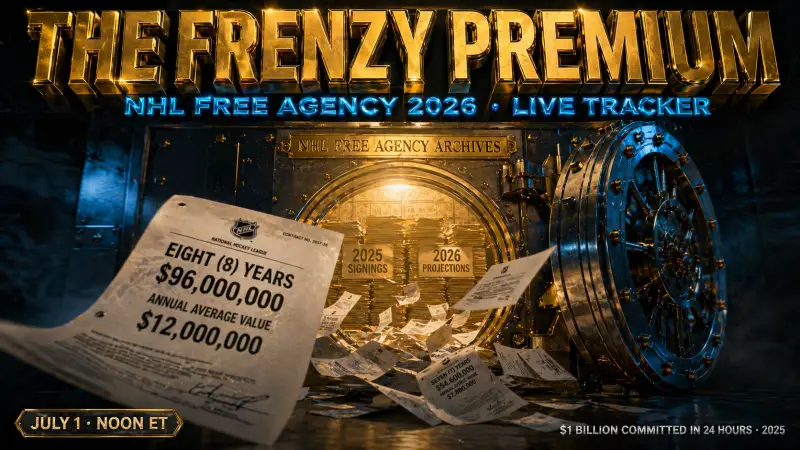
This is what creates the Frenzy Premium. A thin top tier plus the biggest cap leap of the cap era equals AAV inflation that the contract data on July 2 will look strange against on July 31. We've seen the pattern before. In 2025, more than 100 players changed teams and over $1 billion in new contract value was committed in the first 24 hours of the window, with Mitch Marner's eight-year, $96 million Vegas signing leading the headline list and Nikolaj Ehlers' six-year, $8.5 million AAV deal with Carolina anchoring the second tier.
This page is the live tracker for July 1, 2026. Below the framework section, the Top 10 UFA board, the cap-space leaders, and the live signings ledger get updated as deals are confirmed, with sources cited inline. Bookmark this URL. Refresh after noon ET on July 1 for real-time updates.
Key Takeaways
- The Frenzy Premium: Thin top tier plus $8.5M cap jump per team equals AAV inflation that defines the July 1 window.
- Cap math: 2026-27 ceiling locked at $104 million ($95.5M to $104M, +8.9%), floor at $76.9 million per the NHL/NHLPA joint announcement.
- Top UFA forward: Alex Tuch (Buffalo Sabres) signed with Washington at $10.5M AAV over 8 years after a 33-33 regular season and a deeper playoff push.
- Class thinned by extensions: McDavid, Eichel ($13.5M AAV), Kaprizov, Connor, Eklund, and Lowry all signed before reaching open market.
- Live update: This tracker refreshes through July 1 and 2; check the Live Signings Ledger section for confirmed deals.
How the July 1 NHL Free Agency Window Actually Works
The official UFA market opens at exactly 12:00 PM ET on July 1. Before that moment, teams cannot legally negotiate AAV or term with players whose rights belong to other clubs (the exception: a quiet "interview window" that opened June 25, used to discuss general fit but not financial terms). At noon, all 32 teams turn the spigot on simultaneously.
The first 60 minutes are typically the loudest. In 2025, Vladislav Gavrikov signed a seven-year, $7 million AAV deal with the Rangers within an hour of market open. Nikolaj Ehlers landed in Carolina at six years, $8.5 million AAV before dinner. The pattern repeats every year because agents and front offices have been on call lists since the trade deadline. Most signings on July 1 are paperwork, not real-time negotiations.
The TJ Hughes bidding war pattern shows how this dynamic compresses negotiation: when multiple teams want the same player and have cap space at the same time, the AAV doesn't move incrementally, it jumps in chunks.
The Frenzy Premium
The day-one AAV inflation that hits when a thin UFA class collides with unprecedented cap room. Calculated as the gap between July 1 contract AAVs and the AAVs the same player class signs for in the post-frenzy window (typically 10 to 25 percent above market in a tight class year). The 2026 cap leap of $8.5 million per team is the largest fuel injection the Frenzy Premium has ever had.
Top 10 UFAs to Watch on July 1, 2026
The 2026 UFA forward board reshaped twice in the last 12 months. Connor McDavid, Jack Eichel (8 years, $13.5 million AAV with Vegas), Kirill Kaprizov, and Kyle Connor all extended before reaching the open market. The Canucks' restructured front office watched the same wave of extensions take the marquee names off the board. What's left is a more workmanlike top 10, headlined by a winger who could swing the East.
| Player | Position | 2025-26 Team | Asking / Projection |
|---|---|---|---|
| Alex Tuch | RW | Buffalo Sabres | $10M+ AAV reported |
| Anthony Mantha | LW | Pittsburgh Penguins | $5-6M, age 32 |
| Mason Marchment | LW | Seattle Kraken | $5M+ middle-six |
| Charlie Coyle | C | Colorado Avalanche | $4-5M veteran C |
| Cam Talbot | G | Detroit Red Wings | $3-4M backup-starter hybrid |
| Brock Boeser | RW | Vancouver Canucks | $7-8M tier (situation-dependent) |
| Tomas Hertl | C | Vegas Golden Knights | Re-signing edge favors VGK |
| Anze Kopitar | C | Los Angeles Kings | 1-year hometown deal expected |
| Evgeni Malkin | C | Pittsburgh Penguins | 1-year discount expected |
| Alex Ovechkin | LW | Washington Capitals | 1-year extension in place |
Tuch is the only realistic open-market bidding war on this list. The other nine names either have re-signing momentum, age constraints, or are walking into pre-signed extensions. Buffalo's playoff push changed the calculus entirely; one Sabres insider noted the team has "no choice" but to meet Tuch's number after his postseason performance.
The Frenzy Premium, Visualized: Cap-Space Leaders Going In
Three teams enter the July 1 window with the structural advantage of being able to absorb a Frenzy Premium contract without flinching. Two more sit just behind them. The list shifts daily as buyouts and trades clear room, but the May 2026 snapshot looks like this: Anaheim, Chicago, and San Jose hold the top three projected cap-space slots heading in. Each one has either a young top-six gap to fill or a goaltending need that lines up directly with the available UFA pool.
Cap room without a roster need is dangerous in a Frenzy Premium environment. Anaheim, in particular, is the team most likely to convert excess space into a long-term contract that ages poorly. Calgary's offseason planning looks more disciplined by comparison, leveraging cap flexibility into asset trades rather than open-market overpays.
Frenzy Day Pre-Market Audit
Three structural conditions that decide whether the 2026 frenzy beats or trails the 2025 record book.
"The Sabres are going to have to match. His asking price is only going up based on his playoff performance."
Insider note via SabreNoise on Alex Tuch (via SabreNoise)The Tuch situation is the cleanest example of how the Frenzy Premium works. A 33-goal winger from Buffalo's biggest playoff run in 14 years had the entire 2026 UFA forward bidding curve to himself until Washington signed-and-traded for him, and the cap leap means even teams without obvious need have the room to swing.
Cap-Space Heat Map: Frenzy Buyer Index
Three buyer profiles ranked by both projected cap room and spending pressure. Higher score equals higher overpay risk on Frenzy Day.
Live Signings Ledger
This section updates through July 1 and 2 as deals are confirmed by primary sources. Refresh this page after noon ET on Tuesday for the latest. Each entry is verified against PuckPedia, CapWages, or an official team announcement before posting.
| Player | To Team | Term / AAV | Source |
|---|---|---|---|
| Live tracker activates noon ET, July 1, 2026. First confirmed signings appear here within minutes of announcement. | |||
Historical Frenzy Day Precedent: The 2024 Record Sets the Bar
The July 1, 2024 frenzy set the modern single-day record, with more than $1 billion committed in one day; last July 1 was busy but quieter, as the bigger cap let teams re-sign their own. Mitch Marner's eight-year, $96 million Vegas signing alone accounted for nearly 10 percent of total day-one money committed, and Vegas had loaded $12 million of his cap hit before the ink dried. Jonathan Marchessault landed in Nashville at five years, $27.5 million ($5.5M AAV). Brady Skjei signed in Nashville at seven years, $49 million ($7M AAV). The Canucks' Hughes Lure extensions show how some teams locked in their core BEFORE July 1 hit, exactly to avoid the Frenzy Premium math.
What stood out was the velocity. Within the first 90 minutes of market open, replicating the kind of sprint the Dougie Hamilton retention ladder showed when teams move fast on Day 1, five contracts at $7 million-plus AAV (three of them above $7M) were on the books. By 6:00 PM ET, more than 30 deals were public. The 2026 cap structure makes that pace plausible to repeat or exceed, though the headline AAV totals will likely be lower because the elite tier isn't there to absorb $12M+ deals.
"More than 100 players changed teams. More than $1 billion was spent."
NHL.com recap of 2025 Free Agency opening day (via NHL.com)That number is the Frenzy Premium's cleanest annual marker. The 2026 version starts with $8.5 million more per team to spend and a thinner top, which means even matching the 2025 dollar total will require contracts to inflate at the middle of the market.
What Comes Next on July 1, 2026
My read on this market: Tuch lands somewhere in the 7-year, $10.25M AAV neighborhood, with Buffalo most likely to retain after a final 48-hour negotiation exchange. [Update, July 1: Tuch was signed-and-traded to Washington on an 8-year, $10.5M deal before the market opened, see the confirmed table above.] Anthony Mantha gets a 3-year deal in the $5.5M-$6M AAV range from a team like New Jersey or Minnesota. Cam Talbot signs a 2-year hybrid backup-starter deal at around $3.25M AAV from a contender that needed insurance behind a brittle starter. The Scott Laughton journeyman pivot framework applies cleanly to the back half of this UFA class. Most of the 2026 UFA forwards are middle-six pieces playing for term, not AAV.
The other prediction worth making: at least two contracts signed inside the first 90 minutes will look untradeable by November. The combination of $8.5M in fresh cap room across every team, a thin star tier, and Frenzy-Day urgency historically produces 2 to 3 buyout candidates per cycle. The contracts to flag in real time are the ones at term 6+ years for non-elite skaters age 29 and up.
Sources and Reporting
- NHL.com: Official 2026-27 cap announcement ($104M ceiling, $76.9M floor)
- NHL Free Agent Tracker: 2025 opening day signings reference
- NHL.com Recap: $1B+ spend and 100+ player movements stat
- Daily Faceoff: Top 10 UFA rankings and extension impact
- theScore: Tuch reportedly seeking $10M+ AAV
- NHL.com: 2025 Marner contract structure ($96M / 8 years)
- PuckPedia: Real-time contract verification source
- Spotrac: 2026 UFA database
- Daily Faceoff: Salary cap projection context
The Verdict: The Frenzy Premium
The 2026 NHL Free Agency tracker only makes sense if you read it through the Frenzy Premium frame. A record cap leap is meeting a thinner-than-usual top tier, and the math always reconciles the same way: the middle of the market gets paid like the top, and the contracts signed in the first 90 minutes are the ones agents brag about for the next decade. My final read: total day-one spend matches or modestly exceeds 2025's $1 billion mark, but the median contract AAV is what jumps. Watch the 6:00 PM ET headline list on July 1 for the contracts that age fastest.
Frequently Asked Questions
When does NHL Free Agency 2026 start?
NHL Free Agency 2026 opens at 12:00 PM Eastern Time on Tuesday, July 1, 2026. The window technically remains open through the season, but the most concentrated activity occurs in the first 6 to 12 hours, when the biggest names and most of the league's total UFA spending are committed.
What is the NHL salary cap for 2026-27?
The 2026-27 NHL salary cap upper limit is $104 million, confirmed jointly by the NHL and NHLPA. That is an $8.5 million increase from the 2025-26 cap of $95.5 million, the largest single-year cap leap since the cap era began. The salary floor for 2026-27 is $76.9 million.
Who is the top UFA forward in 2026?
Buffalo Sabres winger Alex Tuch was the consensus top forward of the class before Buffalo signed-and-traded him to the Washington Capitals (8 years, $10.5M AAV) on the eve of free agency. The 29-year-old Syracuse native has reportedly asked for an AAV of at least $10 million on his next deal. He posted 33 goals and 33 assists in the 2025-26 regular season before re-shaping his market in the playoffs.
Why is the 2026 UFA class so thin?
Several star players who would have headlined the 2026 class signed extensions before July 1, including Connor McDavid, Jack Eichel (8 years, $13.5 million AAV), Kirill Kaprizov, Kyle Connor, William Eklund, and Adam Lowry. The remaining top tier features Alex Tuch, Anthony Mantha, and a handful of veterans on prove-it deals.
Frequently Asked Questions
When does NHL Free Agency 2026 start?
NHL Free Agency 2026 opens at 12:00 PM Eastern Time on Tuesday, July 1, 2026. The window technically remains open through the season, but the most concentrated activity occurs in the first 6 to 12 hours, when the biggest names and most of the total UFA spending are committed.
What is the NHL salary cap for 2026-27?
The 2026-27 NHL salary cap upper limit is $104 million, confirmed jointly by the NHL and NHLPA. That is an $8.5 million increase from the 2025-26 cap of $95.5 million, the largest single-year cap leap since the cap era began. The salary floor for 2026-27 is $76.9 million.
Who is the top UFA forward in 2026?
Alex Tuch was the consensus top forward of the 2026 class, but he never hit the open market: Buffalo signed-and-traded him to the Washington Capitals on an 8-year, $10.5 million AAV deal before July 1. He posted 33 goals and 33 assists in the 2025-26 regular season. Among forwards who did reach free agency, veterans like Patrik Laine and Anthony Mantha lead a middle-six-heavy group.
Why is the 2026 UFA class so thin?
Several star players who would have headlined the 2026 class signed extensions before July 1, including Connor McDavid, Jack Eichel (8 years, $13.5 million AAV), Kirill Kaprizov, Kyle Connor, William Eklund, and Adam Lowry. The remaining top tier features Alex Tuch, Anthony Mantha, and a handful of veterans on prove-it deals.
Related Stories

How Do Line Changes Work in Hockey?
A line change is hockey's strangest routine: you swap players while the puck is live, but only inside a five-foot pocket beside your own ben...
By Mike Johnson · 10 min read

What Is the Long Change in Hockey?
The long change is not jargon, it is bench geography. Teams switch ends each period but keep the same bench, so in the second period a tired...
By Mike Johnson · 9 min read
What Is a Delayed Penalty in Hockey?
A delayed penalty is not a penalty yet. It is the referee holding the whistle after a foul until the penalized team touches the puck, which...
By Mike Johnson · 9 min read
What Is a One-Timer in Hockey?
A one-timer reaches the net just 42% of the time, the worst of any shot, yet it is the most dangerous weapon in hockey and the shot Ovechkin...
By Mike Johnson · 11 min read
Comments
Be the first to share your take.
Get NHL trade rumors in your inbox
One email per week, zero spam, verified rumors only.