
Elias Pettersson
Contract
Scouting Report
✓ Strengths
✗ Weaknesses
Playing Style
Trade Value Analysis
Career & Biography
Early Life: From Ånge's Zamboni Kid to Sweden's Next Great Center
Elias Pettersson grew up in Ånge, a town of 3,800 people in central Sweden where his father Torbjörn drove the Zamboni at the local rink. That access meant young Elias spent hours on the ice after everyone else went home — extra reps that would eventually produce a center whose stickwork and transition game would eventually produce 200 goals and 500 points before his 28th birthday. He's of Finnish descent on his father's side; his grandfather was sent to Sweden in 1941 as a Finnish war child during World War II. His older brother Emil also plays professional hockey, and the two pushed each other through Sweden's youth development system.
Because Ånge didn't have a competitive junior team, Pettersson commuted 100 kilometres to Timrå IK's youth program starting at age 14. He made his professional debut in HockeyAllsvenskan (Sweden's second tier) during the 2015-16 season before signing with the Växjö Lakers of the SHL in April 2017. What happened next still ranks as one of the greatest under-20 seasons in SHL history.
Pettersson set a new record for most points by a junior in a single SHL season with 56, breaking Kent Nilsson's mark from 1975-76. He then led Växjö to the Le Mat Trophy as SHL champions, winning both the SHL Rookie of the Year and playoffs MVP awards unanimously. The Vancouver Canucks had selected him fifth overall in the 2017 NHL Draft, and by October 2018, he was ready.
Pettersson's NHL Career: The Rise, the Peak, and the Decline
Pettersson's rookie season in 2018-19 was transformative for a franchise starving for hope. He scored 28 goals and 66 points in 71 games, breaking Ivan Hlinka's 37-year-old Canucks rookie record. He won the Calder Trophy as the NHL's top rookie with 151 of 171 first-place votes — the most dominant Calder performance in years. I remember watching his between-the-legs goal against the Avalanche that season and thinking: this kid sees the ice differently than anyone else in Vancouver since the Sedins.
The 2019-20 season proved the rookie year wasn't a fluke — 27 goals and 66 points in 68 games before COVID-19 shut everything down. But 2020-21 was rocky. The shortened season started with Pettersson recording just one goal in his first eight games, and a devastating oblique injury in March ended his campaign at just 26 games and 21 points. I'd argue this was the season that first raised questions about his durability.
Pettersson's career peaked between 2021-22 and 2023-24. He scored 32 goals and 68 points in 2021-22, then exploded for 39 goals and 102 points in 2022-23 — a season that made him look like a legitimate Hart Trophy candidate. The 2023-24 campaign brought 34 goals, 89 points, and a Pacific Division title.
Then came the $92.8 million extension in March 2024 — complete with a full no-movement clause that mirrors the NMC traps that have hamstrung other franchises — and everything since has been a slide. As former Canucks coach Rick Tocchet noted before his departure: "When Petey's on, there's nobody in the league who processes the game faster." The problem is he hasn't been "on" consistently since that contract was signed. His trade value and future with the Canucks became the dominant storyline of the 2025-26 season — a situation that parallels Auston Matthews' own quiet ultimatum in Toronto.
Pettersson's 2025-26 Season: 51 Points and a Franchise in Freefall
The 2025-26 season has been the most difficult of Pettersson's career. Through 73 games, he has 15 goals and 51 points — a 0.70 points-per-game pace that would've been considered a strong season for most centers, but represents a staggering decline from the 102-point player Vancouver committed $92.8 million to. His 46.0% expected goals share (xGF%) and 45.0% Corsi for percentage (CF%) are both career worsts.
Context matters here: Pettersson is playing on a Canucks roster being actively dismantled. Quinn Hughes was traded to Minnesota in December 2025. Conor Garland, Tyler Myers, and Nils Hoglander are all gone. First-year head coach Adam Foote has asked Pettersson to play a heavier, more defensive style.
I've watched enough of his shifts this season to know the offensive instincts are still there — they're just buried under a system that prioritizes survival over creation. He hit the 200-goal, 300-assist, and 500-point career milestones in 2025-26, becoming the second-fastest Canuck to 500 points (533 games, trailing only Thomas Gradin's 529). The milestones feel bittersweet — legacy markers achieved while the team crumbles around him.
Elliotte Friedman reported that the Canucks will sit down with Pettersson this offseason for a "real conversation" about his future, with all options on the table. My read: Pettersson is still a 70-point center on a competent roster. He just needs to not be on the worst team in the league.
Pettersson Off-Ice: A Quiet Life in a Loud Market
Pettersson married longtime partner Katelyn Byrd in a private ceremony in Sweden in the summer of 2024, confirming the news during the Canucks' annual Jake Milford charity tournament. Byrd, an American model, has launched a Swedish candy company inspired by discovering superior European sweets during modeling trips overseas.
Pettersson keeps an exceptionally low profile by NHL standards — no controversies, no public feuds, no social media drama. As a teenager in Ånge, he and his community actively campaigned for the return of two close friends who had been deported to Armenia in 2011, a cause that was eventually successful. It says something about the person underneath the hockey player.
Pettersson Net Worth and Career Earnings in 2026
Elias Pettersson's estimated net worth in 2026 sits between $35-40 million, based on total career NHL earnings of approximately $53.7 million across three contracts. His entry-level deal (2018-21) paid $11.3 million over three years. His bridge contract (2021-24) brought $22 million. And his current eight-year, $92.8 million extension — which includes $47 million in signing bonuses structured to maximize take-home pay under salary cap rules — will push his total career earnings past $117 million by the time it expires in 2032.
After accounting for agent fees (typically 3-5% of contract value), Canadian federal and provincial taxes (British Columbia's top rate exceeds 50% on income above $240,000), and escrow withholdings, Pettersson's actual take-home is substantially less than the headline numbers. His $11.6 million AAV translates to roughly $5.2-5.5 million in after-tax, after-escrow annual income — still generational wealth, but a reminder that NHL contract values and player net worth are very different numbers.
Pettersson's International Career: Sweden on the World Stage
Pettersson has been a consistent presence in Sweden's international program since his teenage years. He won a gold medal at the 2018 IIHF World Championship — the same spring he broke SHL records with Växjö — collecting 13 points (4 goals, 9 assists) in 13 career World Championship games across two appearances (2018, 2019). He also competed at the 2018 World Junior Championship, where a broken thumb limited him to five games but Sweden still claimed silver.
Most recently, Pettersson represented Sweden at the inaugural 4 Nations Face-Off in February 2025, skating alongside the NHL's best in a tournament that featured Canada, USA, Finland, and Sweden. Sweden fell 4-3 in overtime to Canada in a game where Pettersson played heavy minutes. The tournament reinforced his status as one of Sweden's top-tier NHL players — a lineage that includes Nicklas Lidstrom, Henrik Zetterberg, and the Sedins, the same Swedish pipeline that makes Detroit such an appealing trade destination for him now.
Frequently Asked Questions
How old is Elias Pettersson?
Elias Pettersson was born on November 12, 1998, making him 27 years old during the 2025-26 NHL season. He's entering what should be the peak of his career (ages 27-31), which is why the production decline from 102 points in 2022-23 to 51 points in 2025-26 is so concerning for the Canucks. Pettersson became the youngest Canuck to represent the team at an All-Star Game during his rookie year at age 20.
What is Elias Pettersson's contract?
Pettersson signed an eight-year, $92.8 million contract extension on March 2, 2024, with an average annual value (AAV) of $11.6 million. The deal includes a full no-movement clause and runs through the 2031-32 season. The signing bonus structure totals $47 million over the life of the deal, heavily front-loaded into the first three years. At the time of signing, it made him the highest-paid player in Canucks franchise history.
How many goals does Elias Pettersson have in his career?
Through the 2025-26 season, Pettersson has scored 200 career regular-season goals in 544 games with the Vancouver Canucks. He hit the 200-goal milestone during the 2025-26 season, becoming the fourth-fastest Canuck to reach the mark in franchise history (530 games) behind only Pavel Bure (328 games), Tony Tanti (387), and Markus Naslund (509). He has added 8 playoff goals in 30 career postseason games.
Has Elias Pettersson won any NHL awards?
Pettersson won the Calder Memorial Trophy as the NHL's top rookie in 2018-19, receiving 151 of 171 first-place votes. Before reaching the NHL, he won the SHL Rookie of the Year, SHL Forward of the Year, and SHL Playoffs MVP awards in 2017-18 with Vaxjo Lakers. He has been named to the NHL All-Star Game twice and won the Canucks' Cyrus H. McLean Trophy as team scoring leader three times.
Will Elias Pettersson be traded by the Canucks?
Elliotte Friedman reported in April 2026 that the Canucks will sit down with Pettersson for a real conversation about his future, with trade scenarios explicitly on the table. The Detroit Red Wings are considered the frontrunner destination, with over $30 million in projected 2026-27 cap space and a rich Swedish heritage that could appeal to Pettersson. However, his full NMC gives him complete veto power over any trade.
Latest Pettersson Coverage
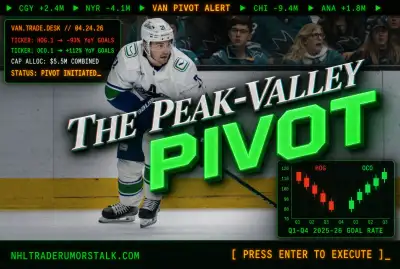
Canucks Trade Candidates 2026: The Peak-Valley Pivot
Canucks trade candidates 2026: Patrik Allvin's The Peak-Valley Pivot. Hoglander ($3M, 2 goals, valley) and O'Connor ($2.5M, 17 goals, peakin...
By Mike Johnson · 13 min read

Canucks Fire Allvin: The Rutherford Mulligan Begins
Patrik Allvin fired after Canucks historic last-place finish. Jim Rutherford, who hired Allvin in 2021, now conducts the GM search himself -...
By Mike Johnson · 9 min read
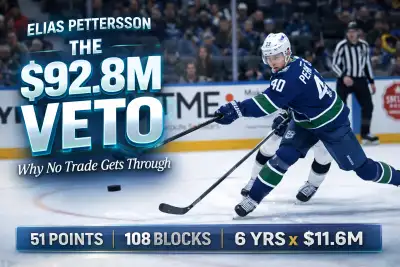
Elias Pettersson Canucks Trade: The $92.8M Veto
Elias Pettersson's full no-movement clause on a $92.8M contract makes him untradeable. Three teams tried. None succeeded. The Decade Veto ex...
By Mike Johnson · 11 min read
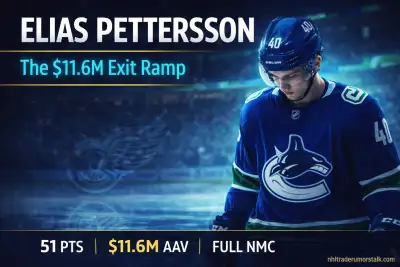
Elias Pettersson Trade: The $11.6M Exit Ramp
Elliotte Friedman reports the Canucks will sit down with Pettersson this offseason for a real conversation about his future. With 51 points...
By Mike Johnson · 9 min read

Boeser Trade: Will Canucks Move Their Last Star? 2026
The Boeser trade question lingers after Brock Boeser survived the March 6 deadline despite interest from the Bruins and Islanders. With a $7...
By Mike Johnson · 6 min read
Get NHL trade rumors in your inbox
One email per week. Zero spam. Verified rumors only.